

This edition of Housing Reframed focuses on homeowners insurance and exploring system interactions that may cause low-income homeowners to pay more for less.
June marks the start of Hurricane Season, which means conversations across Florida are once again turning to preparedness, risk, and the cost of homeowners insurance.
Homeowners know these conversations all too well: Florida is consistently ranked among the most expensive for home insurance. As state legislators continue to work on legislation aimed at stabilizing Florida’s insurance market, household budgets are eager for relief from the rising costs.
Rather than rehash how much prices have risen (a well-documented trend), a recently released Urban Institute report takes a closer look at the mix of factors associated with high household premiums. One finding stands out immediately.
Low-income mortgage holders face what the researchers call a “double burden.” Not only do they have less income available to absorb high insurance costs, but they also tend to pay higher insurance rates relative to the value of their homes.
The Urban Institute report indicates that borrowers earning below 50% of area median income (AMI) pay approximately $2.10 more in homeowners insurance per $1,000 of home value than borrowers earning above 120% of AMI. For a $400,000 home, that difference amounts to roughly $840 per year.
That takeaway bears repeating: Households with the fewest financial resources are paying more for insurance relative to the asset they are protecting. Why?
A range of system factors contribute to this pattern, and the report identifies several characteristics associated with higher insurance burdens. Some are intuitive.
For example, neighborhoods with older housing stock are associated with higher insurance costs. That matters because more affordable ownership opportunities are often found in older homes. But an older home can come with high secondary costs: aging plumbing, an outdated electrical system, or older roof.
From an insurance perspective, those features can increase the likelihood or cost of future claims. The same home that is more attainable on the purchase side may become more expensive to insure over time.
However, financial characteristics of the buyer also seem to predict higher insurance rates, not just the age of the home. The report shows that borrowers with lower credit scores and/or higher debt-to-income (DTI) ratios were more likely to experience insurance affordability challenges. Individually, each of these factors appears straightforward, but together they reveal something more interesting: a reinforcing feedback loop.
Consider an example from a typical low-income household struggling to make ends meet:
- Without financial breathing room, credit cards often bridge the gap, leading to a higher DTI ratio and a poor credit score.
- Poor credit results in higher monthly mortgage payments and insurance payments. (Research cited in the report shows that credit scores influence insurance pricing as well as mortgage pricing.)
- Higher monthly insurance costs reduce a household’s ability to save or pay for unexpected repairs on their home.
- The home falls into a state of disrepair, which also contributes to higher insurance prices or being dropped from a policy altogether.
- Higher insurance prices continue to erode monthly budgets, and the household is back at the beginning of the cycle.
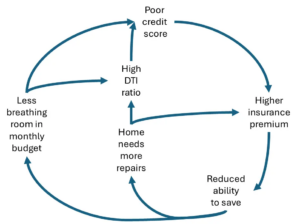
The systems diagram illustrates the connection points of this feedback loop. Viewed this way, insurance premiums do not simply reflect financial vulnerability, they are part of a self-amplifying system.
The reality of these struggles is apparent every day at Habitat Orlando & Osceola.
“Insurance costs have become an increasingly important part of the affordability equation,” said Jennifer Gallagher, Habitat Orlando & Osceola’s Chief Operating Officer. “For many families, the challenge is no longer just qualifying for a mortgage. Rising insurance premiums can be the difference between a sustainable monthly payment and one that pushes a household beyond safe financial limits.”
Similar dynamics impact homeowners who have paid off their mortgages. Once insurance is no longer required, homeowners may choose to take the risk and drop an unaffordable policy. This leaves them vulnerable if anything happens to their home; creating a comparable feedback loop.
The issues described above are not new. What appears to be changing is the magnitude of the effect. As insurance premiums rise across the board, the consequences are felt most acutely by households with the least flexibility to absorb additional costs.
The Urban Institute report helps us better understand how housing, lending, insurance, and household finances interact. The finding that low-income borrowers face both higher relative insurance costs and lower capacity to absorb those costs is evidence that affordability challenges often emerge from multiple parts of the housing system operating in tandem.
Recognizing that dynamic is the critical first step. After all, it is difficult to interrupt a feedback loop if you cannot see it.
To receive updates on how data, policy, and partnership come together to make lasting change in the housing system, subscribe to our Housing Reframed e-newsletter here.