
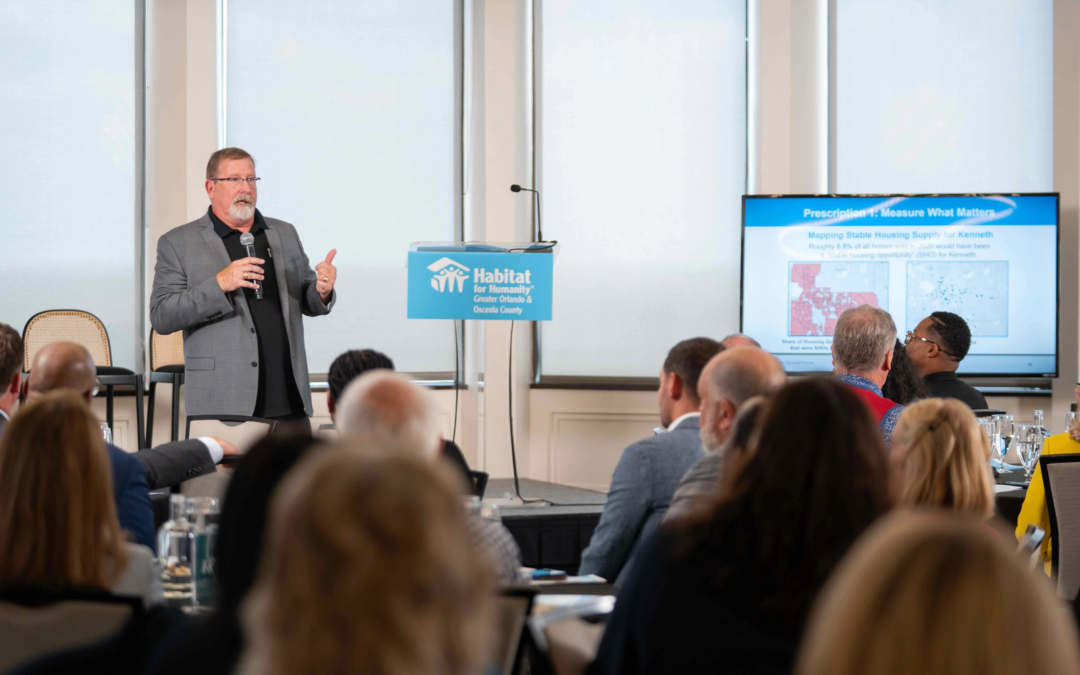
At our inaugural Cornerstone Housing Forum this April, we continued our focus on the upstream view of housing. Habitat Orlando & Osceola’s work will always include responding downstream to the pain points of the crisis families face every day. But lasting progress also requires looking upstream to understand and address the systemic failures that keep producing those hardships in the first place.
This is where systems thinking becomes essential, and the role of measurement is critical.
If we measure the wrong things or rely on measures that cannot reveal how the system is actually performing, then even well-intentioned policy development and collective action begin to break apart. Leaders may still act, but they do so with an incomplete picture. They respond to visible pain without seeing the structural conditions producing it. And without a shared way to measure what matters, sectors struggle to align around the same problem, test the same assumptions, or judge whether progress is real.
That distinction matters. Much of American housing policy has been shaped by measures that describe distress after it has already taken hold. These measures can help identify hardship, but they do not tell us enough about whether the housing system itself is producing the conditions for stability.
They are often better at describing symptoms than diagnosing causes. As a result, communities can remain trapped in a cycle of reacting to visible problems without gaining the insight needed to redesign the underlying system.
A systems approach does something different. It asks whether the system is generating real opportunities for households to live with stability after accounting for the full realities of daily life.
It shifts the frame from “Who is struggling right now?” to “What is the system making possible, for whom, and where?” That change in perspective is not semantic. It is strategic. It expands the decision space. It helps leaders see structural gaps, align fragmented efforts, and test interventions based on how the whole system behaves rather than how one metric moves in isolation.
This is especially important in a region like ours, where housing outcomes are shaped by overlapping systems, not housing alone.
A teacher’s path to stable housing is shaped not just by the price of a home, but by transportation, healthcare costs, and childcare.

The same is true for childcare workers, firefighters, medical assistants, and countless others whose work sustains our community.
When systems thinking is absent, these realities are flattened into averages and broad categories. When systems thinking is present, we can begin to see people not as abstract income bands, but as essential participants in the life of the region.
That is why Cornerstone Housing is grounded in the belief that housing systems change requires more than urgency. It requires a common framework for understanding performance, a more human-centered way to define stability, and a learning process that allows communities to adapt as conditions change.
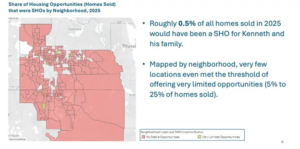
At the recent Forum, we introduced one part of that work: a new way to measure whether the market is actually producing stable housing opportunities. But the deeper point is larger than any single metric. What matters most is building the civic capacity to see housing as a system, respond to it as a system, and improve it through coordinated action.
To receive updates on how data, policy, and partnership come together to make lasting change in the housing system, subscribe to our Housing Reframed e-newsletter here.
Originally distributed on April 23, 2026