
In Orange County, west of Interstate 4, there is a neighborhood where residents are healthier than average. People are more likely to be up to date on medical visits, have health insurance, and report lower rates of diabetes, obesity, and poor mental health days. However, residents struggle to attain college degrees, afford housing, and access the internet.
Meanwhile, in a different Orange County neighborhood south of downtown Orlando, residents are far more likely to be able to afford their homes, as cost burden rates are low for both renters and owners. People also experience almost universal pay equity between men and women. However, residents live near heavy traffic and designated superfund sites. Rates of traffic accidents are worse than average for this smaller neighborhood.
What do these neighborhoods have in common? On the surface, both are demographically similar. Both are majority-minority neighborhoods without any noteworthy differences in age distribution. Each also has a median household income lower than the regional average. In both neighborhoods, residents struggle to afford internet access.
Demographic and economic data, such as race and income, mask the unique strengths and challenges that different neighborhoods possess. Given only this information to work with, nonprofits and local governments are at risk of misallocating resources or missing key interactions between housing, health, education, and safety.
The ability to quickly see the varying outcomes of individual neighborhoods, just like the two described above, is the power of a new tool developed by Habitat for Humanity Greater Orlando and Osceola County under the Cornerstone Housing™ Initiative.
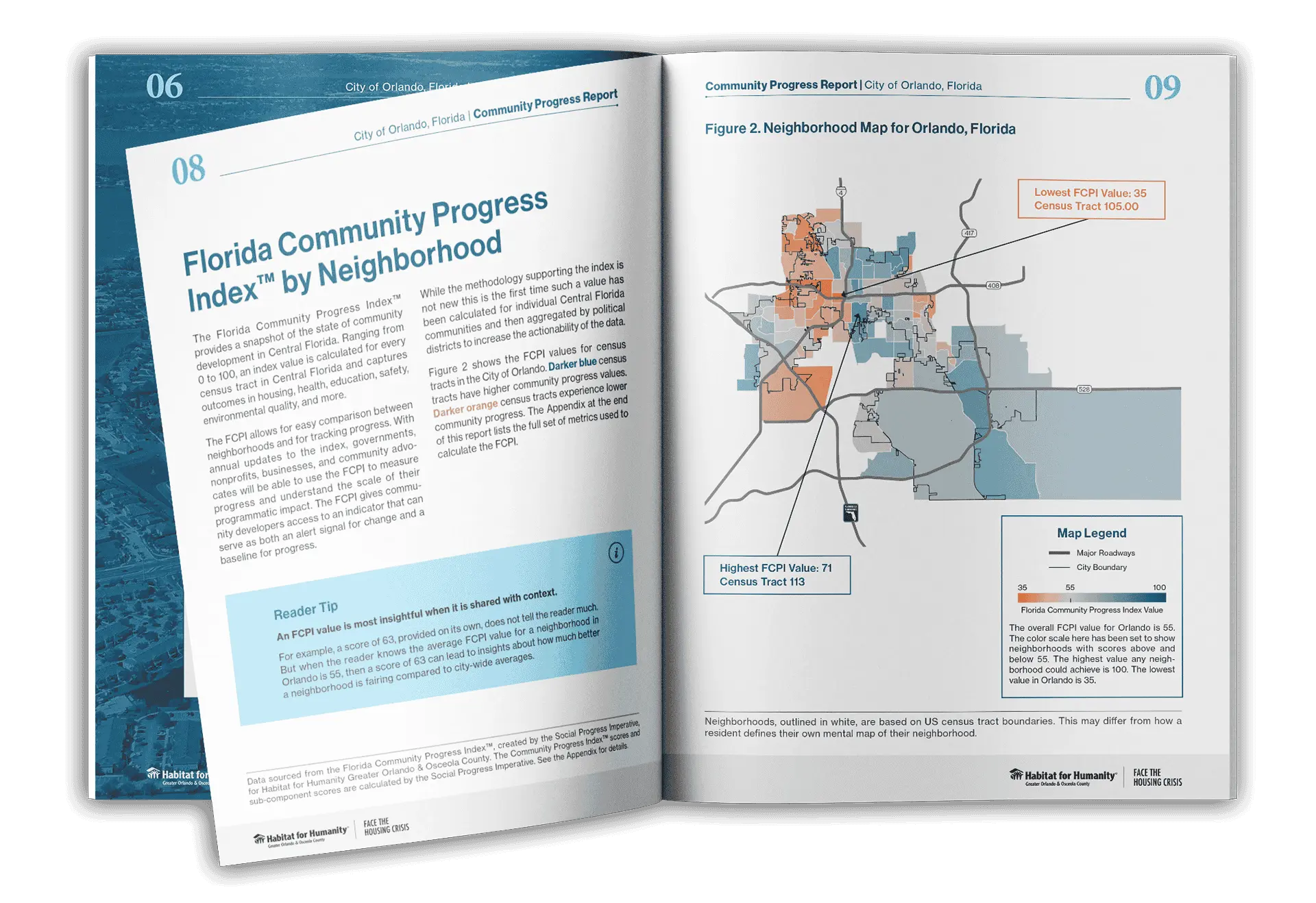
The Florida Community Progress Index™ (FCPI™) is a measurement tool that highlights community data at the micro level, revealing the strengths and challenges of individual neighborhoods in Orange and Osceola counties. This is a tool measuring community progress, and as such, includes data points summarizing housing, health, education, safety, and more in a format that is not available anywhere else. These individual data points are then summarized into a single metric—an index value that tracks neighborhood change over time.
The neighborhood west of I-4, with better health outcomes but struggling housing outcomes, is a part of Pine Hills. It is also the neighborhood where Habitat Orlando & Osceola recently completed our first major home repair. The neighborhood south of downtown Orlando, with better housing affordability but heavier traffic, is part of Holden Heights. Holden Heights is the same neighborhood where Habitat Orlando & Osceola has constructed more than 60 homes over the course of 35 years.


Interestingly, both neighborhoods have very similar overall FCPI™ values. Measured on a scale of 0 to 100, with 100 representing the best possible outcomes, the Pine Hills neighborhood has an FCPI™ value of 46 while the Holden Heights neighborhood has a value of 47. The lowest neighborhood value in Orange County is 35 while the highest is 72. You can click here to learn more and download individual FCPI™ reports.
“We know that not every neighborhood is the same or needs the same services. The summary index value can alert us to general neighborhood need, while the more detailed metrics quickly uncover the neighborhood dynamics at play,” said Dr. Dale A. Brill, Habitat Orlando & Osceola’s Chief Policy Officer.
Habitat Orlando & Osceola created the FCPI™ because nonprofits and governments deserve better tools for identifying where their services are most needed. Armed with more holistic insights, nonprofits could approach a neighborhood with a better sense of the wraparound services or partnerships they need to bring to the table.
“The really novel aspect of this tool is that, over time, with more releases of the index, we will be able to see how and where progress in neighborhoods is improving,” said Brill. “Consider this a baseline year. As we move forward, we will be able to uncover the unique dynamics that lead to progress in different Orange and Osceola County neighborhoods.”
The historic data does not exist to definitively say that housing outcomes are better in Holden Heights today solely because Habitat Orlando & Osceola has built 60 homes there. However, it is an encouraging sign to see that currently housing affordability in Holden Heights is better than regional averages.
“We’re playing the long game,” said Catherine Steck McManus, Habitat Orlando & Osceola’s CEO. “We’ve been building affordable homes in the community for almost 40 years and are excited to create even greater impact moving forward. The big difference now is that we will be able to measure it.”
If you are interested in staying up-to-date on topics like this, click here to subscribe to Housing, Reframed — the newsletter where new perspectives on data, policy, and partnership come together to make lasting change in the housing system.