
Housing+
Exploring the intersection between housing and various aspects of community progress.

Housing+ Series
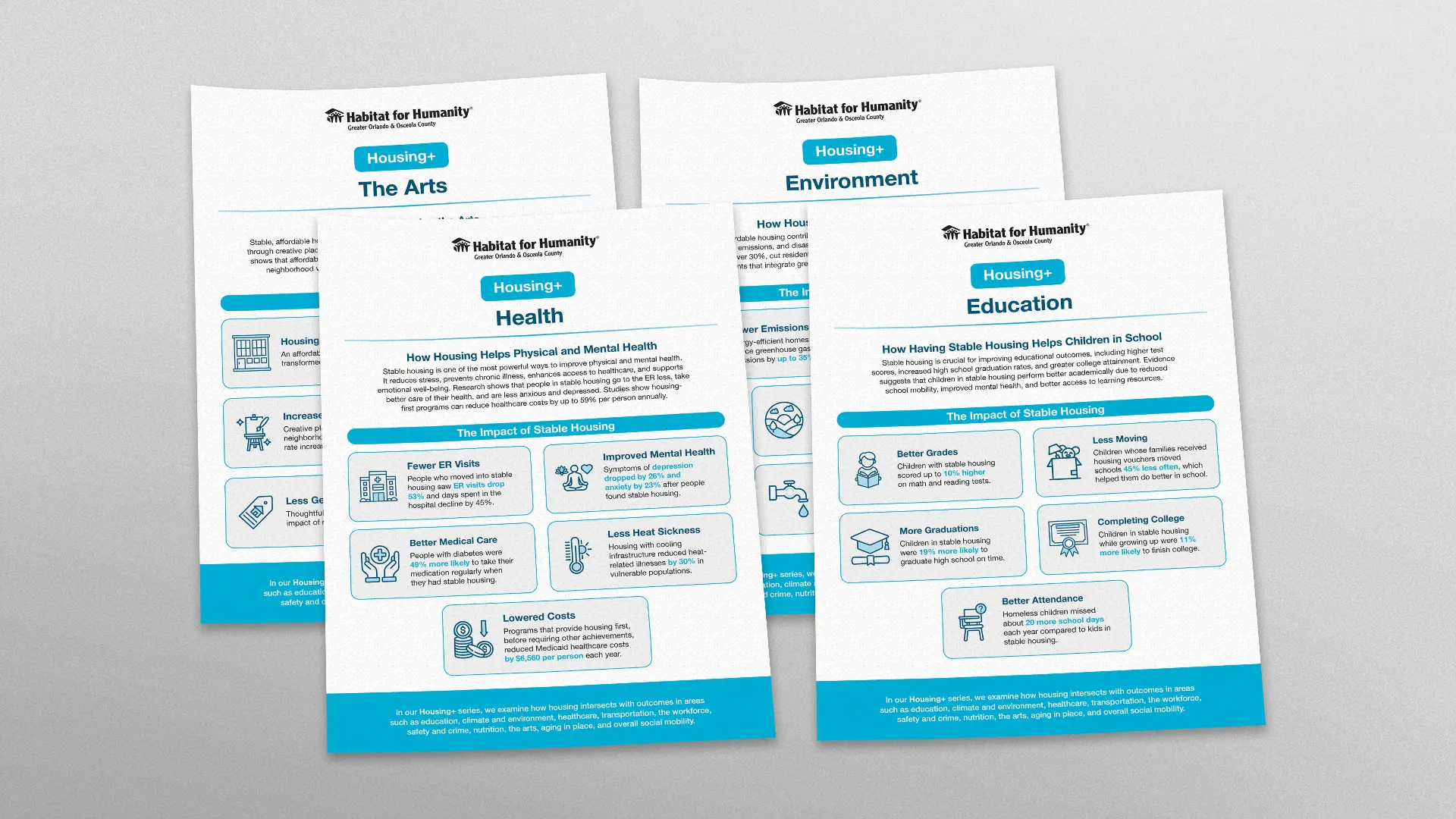
In our Housing+ series, we examine how housing intersects with outcomes in the following areas:
- Aging in Place
- Arts
- Business
- Education
- Environment
- Food
- Health
- Social Mobility
- Transportation
The Impact of Stable Housing
At Habitat Orlando & Osceola, we know that housing is the cornerstone of community progress. Affordable and stable housing is the foundation for thriving communities. Housing is where health is nurtured, education is strengthened, and opportunities are unlocked. It’s the key to a vibrant economy and a strong regional workforce. Below are a few examples of the impact of stable housing.

Better Grades
Children with stable housing scored up to 10% higher on math and reading tests.

Extended Independence
Seniors living in affordable, age-appropriate housing were 45% less likely to be admitted to a nursing home within a two-year window.

Improved Mental Health
Symptoms of depression dropped by 26% and anxiety by 23% after people found stable housing.

Worker Reliability
Employee-assisted housing programs have consistently shown to reduce turnover (from about 15% to 5% in one study), absenteeism, and tardiness.

Food Access
Children in families facing housing insecurity, including frequent moves or overcrowding, are far more likely to skip meals and have poor diets.
Housing+ Report Citations
The evidence presented in the Housing+ reports was sourced from academic studies and journals. A full list of sources, organized by topic, is included below. Note that some sources may not be publicly accessible without subscribing to certain journals or academic institutions.
Housing+ Aging in Place
- Adel, A. “Supporting Aging-in-Place: A Scoping Review.” University of Calgary, 2021.
- Dieker, J. A., et al. “Aging in Place in an Intergenerational Housing Community.” UCCS Gerontology, 2020.
- Jenkins Morales M, Robert SA. The Effects of Housing Cost Burden and Housing Tenure on Moves to a Nursing Home Among Low- and Moderate-Income Older Adults. Gerontologist. 2020 Nov 23;60(8):1485-1494.
- Park, Sojung, et al. “Influence of Senior Housing Types on Nursing Home Admissions Among Older Adults in the U.S.” Aging & Mental Health 24, no. 4 (2020): 566–573.
Housing+ The Arts
- Furtado, Larissa, and Joanna Payne. “Inclusive Creative Placemaking through Participatory Mural Design: A Case Study from Toronto, Canada.” Journal of the American Planning Association 89, no. 2 (2023): 212–225.
- Markusen, Ann, and Anne Gadwa. Creative Placemaking. Washington, DC: National Endowment for the Arts, 2010.
- Treskon, Lou. Measuring Creative Placemaking: Assessing the ArtPlace America Community Development Investments Projects. Washington, DC: Urban Institute, 2015.
Housing+ Business
- Econsult Corporation. “Potential Economic and Fiscal Impacts of a Pennsylvania Housing Trust Fund” 2009.
- Maxfield Research Inc. “The Link Between Affordable Housing and Economic Development.” 2001.
- Metropolitan Planning Council. “Employer-Assisted Housing.” 2006. https://archive.metroplanning.org/work/project/8
- National Association of Home Builders. “The Local Economic Impact of Typical Housing Tax Credit Developments.” 2010.
- Wardrip, Keith, Laura Williams, and Suzanne Hague. “The Role of Affordable Housing in Stimulating Local Economic Development.” Center for Housing Policy, 2011.
Housing+ Education
- Broton, Katharine. “The Evolution of Poverty in Higher Education.” Wisconsin HOPE Lab, 2017.
- Cordes, Sarah A., Jisung Han, and Amy Ellen Schwartz. “Housing, Neighborhoods, and Education.” Oxford Research Encyclopedia of Economics and Finance, 2022.
- Herbers, Janette E., et al. “School Mobility and Developmental Outcomes in Young Children.” Educational Researcher 41, no. 9 (2012): 366–374.
- Newman, Sandra J., and C. Scott Holupka. “Housing Affordability and Child Well-Being.” Housing Policy Debate 25, no. 1 (2015): 116–151.
- Rothstein, Richard. “The Racial Achievement Gap, Segregated Schools, and Segregated Neighborhoods.” Economic Policy Institute, 2014.
Housing+ Environment
- Ahmad, Muhammad. “An Amphibious Architectural Approach to Rising Sea Levels.” SSRN, 2024.
- Environmental Protection Agency. “Delivering on Efficiency in Orlando, FL.” WaterSense Labeled Homes, 2023.
- Ewing, Reid, and Robert Cervero. “Travel and the Built Environment.” Journal of the American Planning Association 76, no. 3 (2010): 265–294.
- Usai, Francesca. “Engineered Living Materials for Sustainable and Green Applications.” PhD dissertation, University of Cagliari, 2025.
Housing+ Food
- Cutts, Diana & Meyers, Alan & Chilton, Mariana & Black, Maureen & Heeren, Timothy & Cook, John & Casey, Patrick & Berkowitz, Carol & Cuba, Stephanie & Coleman, Sharon & Geppert, Joni & Frank, Deborah. (2008). Housing instability impacts food security and well-being in young children.
- Denary W, Fenelon A, Whittaker S, Esserman D, Lipska KJ, Keene DE. Rental assistance improves food security and nutrition: An analysis of National Survey Data. Prev Med. 2023 Apr
- Easterly, Jaylynn, et al. UNI INSPIRE, 2024. https://scholarworks.uni.edu/csbsresearchconf/2024/all/71
- Fernández CR, Licursi M, Wolf R, Lee MT, Green NS. Food insecurity, housing instability, and dietary quality among children with sickle cell disease: Assessment from a single urban center. Pediatr Blood Cancer. 2022 May
- Hatem, C., Lee, C. Y., Zhao, X., Reesor-Oyer, L., Lopez, T., & Hernandez, D. C. (2020). Food insecurity and housing instability during early childhood as predictors of adolescent mental health. Journal of Family Psychology, 34(6), 721–730.
- Jackson CL, Hart CA, Uribe-Lacy CJ, Yang P, Tsai J. A Meta-analysis of the Prevalence of Food Insecurity Among People Experiencing Housing Insecurity and Homelessness in the United States. Public Health Rep. 2025 Jan
Housing+ Health
- Jabali, Omar, et al. “Examining the Nexus between Housing Conditions and Health Outcomes.” BMC Public Health 25 (2025).
- Kalicum, Jasmine, et al. “Perceived Impacts of North America’s First De-Medicalized Safer Supply Program.” Substance Abuse Treatment, Prevention, and Policy 20 (2025): 1–10.
- Kennedy, Mary, et al. “Housing First Is Associated with Reduced Emergency Care Use.” Health Affairs 40, no. 5 (2021): 744–752.
- Noor, Janan, et al. “Heat-Related Health Risks for People Experiencing Homelessness.” Journal of Urban Health 102 (2025): 100–111.
- Rawhouser-Mylet, Gretchen, and Robert Barclay. “Unlocking the Potential of the Lutheran Ecosystem.” Abt Associates, 2024.
Housing+ Social Mobility
- Chetty, Raj, et al. “Opportunity Atlas.” Opportunity Insights, 2018. https://opportunityinsights.org/paper/the-opportunity-atlas/
- Chetty, Raj, et al. “The Effects of Exposure to Better Neighborhoods on Children.” American Economic Review 106, no. 4 (2016): 855–902.
- Cutts, Diana & Meyers, Alan & Chilton, Mariana & Black, Maureen & Heeren, Timothy & Cook, John & Casey, Patrick & Berkowitz, Carol & Cuba, Stephanie & Coleman, Sharon & Geppert, Joni & Frank, Deborah. (2008). Housing instability impacts food security and well-being in young children.
- Fernández CR, Licursi M, Wolf R, Lee MT, Green NS. Food insecurity, housing instability, and dietary quality among children with sickle cell disease: Assessment from a single urban center. Pediatr Blood Cancer. 2022 May
- Jabali, Omar, et al. “Examining the Nexus between Housing Conditions and Health Outcomes.” BMC Public Health 25 (2025).
- Katz, Lawrence F., Jeffrey R. Kling, and Jeffrey B. Liebman. “Moving to Opportunity in Boston: Early Results of a Randomized Mobility Experiment.” Quarterly Journal of Economics 116, no. 2 (2001): 607–654.
Housing+ Transportation
- Blumenberg, Evelyn, and Fariba Siddiq. “Commute Distance and Jobs‑Housing Fit.” Transportation 50, no. 3 (June 2023): 869–891.
- Center for Transit-Oriented Development. “TOD Database.” https://toddata.cnt.org
- Center for Neighborhood Technology. “H+T Index.” https://www.cnt.org/tools/housing-and-transportation-affordability-index
- Hongwei Dong, Evaluating the impacts of transit-oriented developments (TODs) on household transportation expenditures in California, Journal of Transport Geography, Volume 90, 2021, 102946, ISSN 0966-6923, https://doi.org/10.1016/j.jtrangeo.2020.102946.
- Southern California Association of Governments (SCAG). “2016 RTP/SCS.”
- Zhang, Ming. “Can Transit Oriented Development Reduce Peak Hour Congestion?” Transportation Research Record 2174 (2010): 148–155.